The RCOT Awards 2022

The RCOT Awards 2022

I was very honoured to be invited as a guest to the annual RCOT Awards to recognize the incredible achievements of occupational therapists over the past 3 years. It was an amazing day and I was truly humbled to hear of some of the profession-changing things that had taken place and that people had been rewarded for. However, I was struck by something; in 2022, not a single person was nominated for a Merit Award. What has gone wrong with our profession that we haven’t spent the time to reward the amazing achievements that are being made?

Students cannot be nominated, despite some students making some incredible contributions to the profession. Nominations are very complex and the forms are long and this is quite a time intensive process. Maybe if the forms were shorter and easier to complete this may encourage more people to send them in? Or a short form sent in for round 1 of selection, and more information sent in if the person is selected? What about sending in video applications?

Do people feel disengaged from our profession and professional body? Is there a feeling that you couldn’t ‘win’ an award and that it is just for certain people? This could not be further from the truth. Anyone could win an award, so please ensure that you nominate someone if you feel that they have made a big contribution to occupational therapy. It is important for our profession that we reward people.

Do you have any ideas on how we can ensure that we are recognizing people and ensuring that Merit Awards are rewarded next year? What would you suggest?

My other concern was that the dark shadow of COVID-19 hung over us, the unspoken elephant in the room that nobody wanted to acknowledge, so we could all pretend that we hadn’t missed two award ceremonies because of a deadly global pandemic. At least one of the Award recipients could not attend due to COVID-19. Again, we discussed hybrid, why has the country tried to go back to working 100% face to face when hybrid working worked so successfully for so many, and made the lives of disabled people so much richer. I think we need to try to remember the lessons which we learned during the pandemic and embrace the technology, rather than throw it away. Hybrid working is a fantastic way to reduce carbon emissions, it could help with the overcrowding it cities, allow people to move to cheaper areas of the country and have a better quality of life and financial freedom. The world doesn’t care enough about disabled people to do it for us, but I hope it cares enough about the combination of reasons. Wouldn’t it have been lovely if that Award winner could have joined us virtually by a hybrid set up to see the awards ceremony and at least say thank you for her award and be clapped by the audience. That would have shown how much her contribution to occupational therapy is respected and appreciated.

All in all, myself and my AbleOTUK colleagues had a great time at the awards, and it was lovely to meet each other in real life for the first time. I hadn’t been to London in over ten years, so it was a big adventure! I felt very fatigued and sore yesterday after all that excitement.
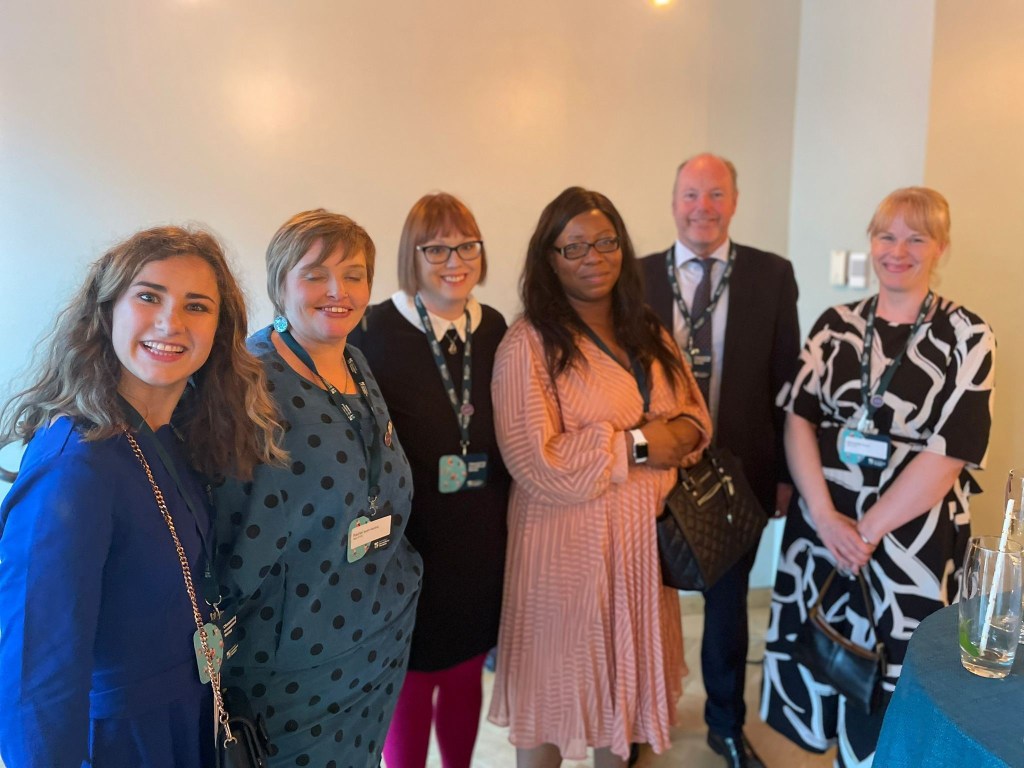
Standing in a line, from left, a lady in a blue dress with long wavy hair, Georgia Vine.  A lady in a green spotty dress and short hair, Rachel Booth-Gardiner.  A lady in a black dress with white collar and pink tights and short bob, Natalie Hicks, a Black lady in a pink long sleeve dress with long wavy black hair, Anne-Marie Fadare, a man in a suit, Steve Ford, a woman in a black and white knee length dress, blond hair put up, Sam Pywell.,
The women are Founding Members of AbleOTUK and Steve Ford is the Chair of the Royal College of Occupational Therapists
Standing in a line, from left, a lady in a blue dress with long wavy hair, Georgia Vine. A lady in a green spotty dress and short hair, Rachel Booth-Gardiner. A lady in a black dress with white collar and pink tights and short bob, Natalie Hicks, a Black lady in a pink long sleeve dress with long wavy black hair, Anne-Marie Fadare, a man in a suit, Steve Ford, a woman in a black and white knee length dress, blond hair put up, Sam Pywell.,
The women are Founding Members of AbleOTUK and Steve Ford is the Chair of the Royal College of Occupational Therapists

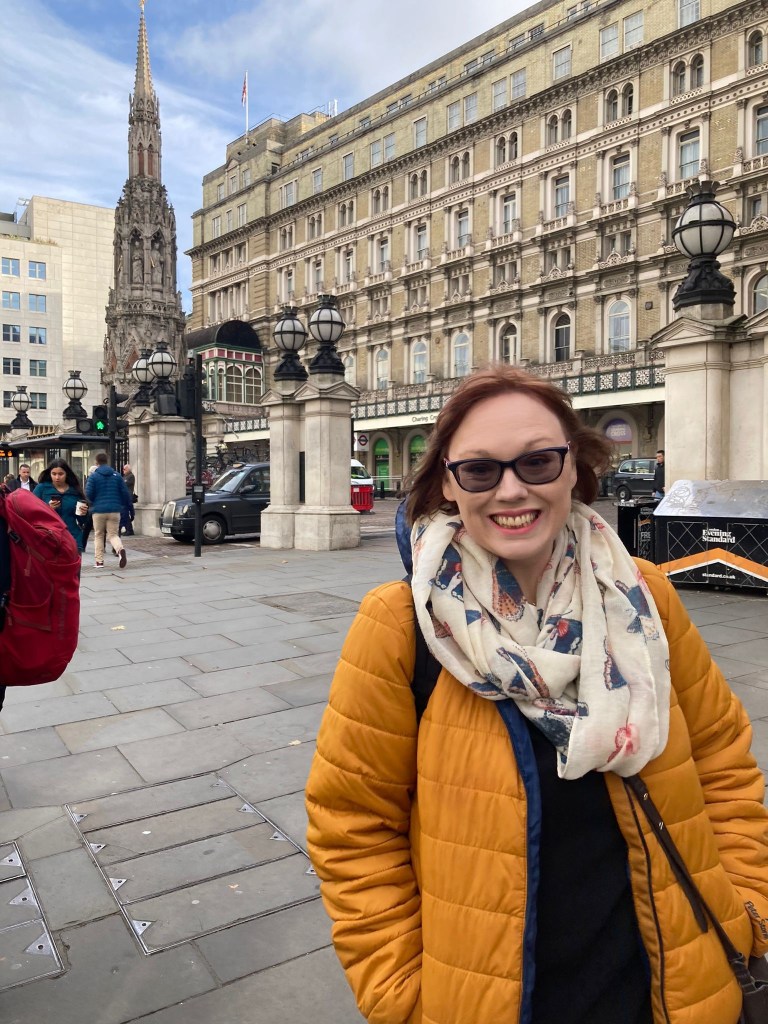
Natalie Hicks a woman with glasses standing outside Charing Cross train station London

Natalie Hicks a woman with glasses standing outside Charing Cross train station London
Concerns of a Disabled OT

Concerns of a Disabled OT

We now have a new PM (again) and a new Chancellor in the UK. PM Sunak told us yesterday that “difficult decisions (are) to come” regarding the economy (GOV.UK, 2022a). He is promising “a stronger NHS”, and “leveling up” (GOV.UK, 2022a), with Jeremy Hunt by his side, who is well remembered as the Health Secretary for six years, under austerity. He was responsible for the biggest shake-up of the NHS in memory and drove junior doctors to strike against contractual changes in 2016, which significantly impacted healthcare (BMJ, 2018).

As a disabled adult, a final-year occupational therapy student, and parent to two disabled children, I have to admit that a return to austerity is concerning me a great deal. I remember under the years of austerity the change from Disability Living Allowance (DLA) to Personal Independence Allowance (PIP) has really prevented many disabled people from being able to claim benefits – 67% of all tribunals result in a decision being overturned, which shows that this benefit is not supporting disabled people (GOV.UK, 2022b). My eldest son is about to turn 16 and I have to apply for PIP for him. This is really making me anxious, as I felt so nervous about the PIP process, that I couldn’t bring myself to apply.

With the NHS in the mess that it is currently in, with ambulances currently being used as extra wards, as there are no beds available in the Emergency Department or the hospital proper – it is no surprise that one person has died in the back of an ambulance. What is surprising is that there have not been more deaths. The NHS needs investment, which includes pay rises for the staff. According to the Royal College of Nursing, the nursing profession is at breaking point, due to the cost of living crisis, years of austerity, no cost of living pay rises, and staff leaving in droves (Royal College of Nursing, 2022a). The survey to the members of the Royal College of Nursing reported shocking results;

  • Eight in 10 (83%) said there weren’t enough nursing staff to meet all patient needs safely and effectively on their last shift. 
  • Just a quarter (25%) of shifts had the planned number of registered nurses. 
  • Less than one in five (18%) said they had enough time to provide the level of care they’d like.

(Royal College of Nursing, 2022b).

The Royal College of Occupational Therapists, of which I am a member, is advocating for the social care sector rather than the NHS, which is also expressly in crisis. They are requesting investment in people, recruitment and retainment of staff, again requesting better pay and also career opportunities, more support for children’s services of which 85% have reported being understaffed, support people from all backgrounds to become health professionals and tackle health inequalities – and they mention the delayed white paper (Royal College of Occupational Therapists, 2022).

This is the current health of the NHS and social care, prior to the ‘new’ Conservative government’s round of cuts in austerity mark II. I feel we have a lot to be afraid of as a nation.

References

Language and Discrimination by Natalie Hicks (@nataliehixy)

Language and Discrimination by Natalie Hicks (@nataliehixy)

I

@OT_rach's avatarAffinOT

Natalie Hicks 3rdYear Occupational Therapy Student (BSc Hons) at the University of Central Lancashire and one of Able OTUK founding members – shares her thoughts in this blog post, please comment and share.

Throughout the years language has been used to control and divide people, as a way to scapegoat the ‘other’. The people would turn against those who were ‘beneath’ them (in their mind), rather than those ‘above’ them. White Wealthy European Men were at the top of the social order hierarchy, and anyone below this was discriminated against, and treated with abject brutality. We now live in the 21st Century, a time of iphones, WiFi, Zoom Calls and Netflix – we don’t surely discriminate and have this hierarchy now, do we?

Source: (Lushch, 2020)

We only have to go back a generation to when it was deemed acceptable to put up a sign saying ‘No Irish…

View original post 993 more words

Why?

Why?

Well, I have seen so many people who have blogs about their lives, and I had always thought my life so boring. However I have realised that maybe, I do have something to share with the world. There are others out there in the world who are like me, who maybe would like to read about someone like them.

We do not have enough positive representation of disabled people in the world. Since 2010, there has been a shift in the media, and now disabled people are portrayed in a negative light in the media (Bryant, Watson & Philo, 2013), so it is really important so us to show how absolutely incredible we are, and that we are not benefit stealers, we DO contribute to society.

I also think that it is really important to raise awareness about the difficulties that disabled students face in universities, on placements, in work etc. I have faced far more barriers than people realise, and yet I am still here. It has taken me longer to get here, but I am here. I would like to raise awareness of the difficulties that disabled people face day in, day out, and why they may need to take extensions on the regular, or why you as their colleague need to lift them up.

I want to raise awareness about ableism – what it is, and why as a society, we need to become ableism aware, and why we need you to become allies of disabled people.

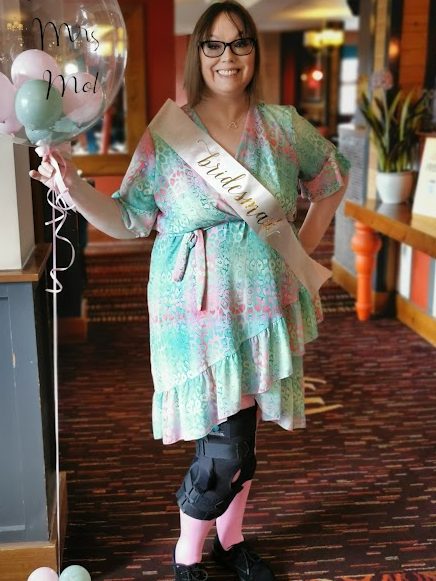
This is me at the start of my sister’s hen party.

Emma Briant, Nick Watson & Gregory Philo (2013) Reporting disability in the age of austerity: the changing face of media representation of disability and disabled people in the United Kingdom and the creation of new ‘folk devils’, Disability & Society, 28:6, 874-889, DOI: 10.1080/09687599.2013.813837